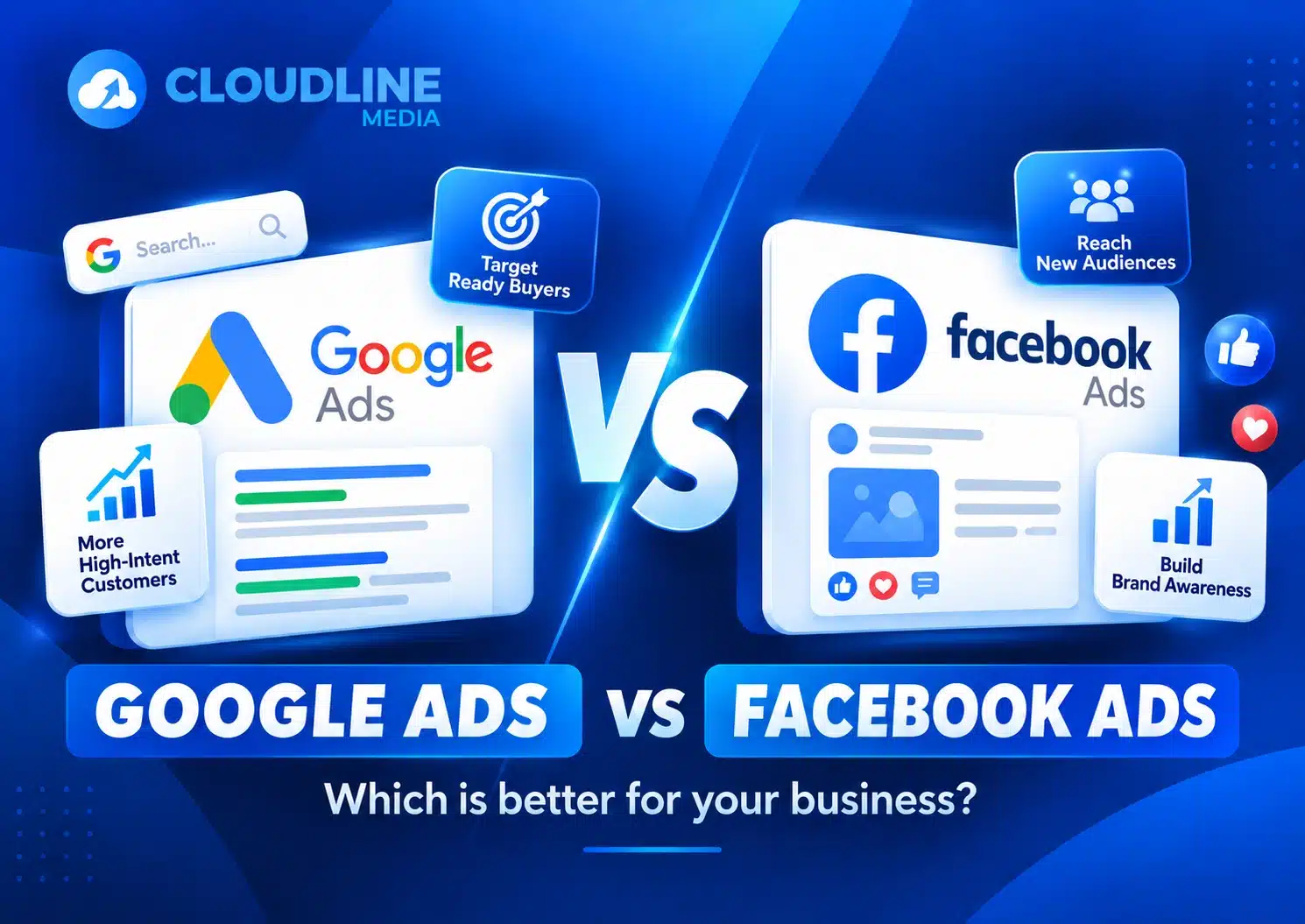
Google Ads vs Facebook Ads are two of the most popular ways to promote a business online. Both can help you reach potential customers, generate enquiries and increase sales, but they reach people at different stages of the buying journey.
Choosing between them depends on your business, audience, goals and budget. Google Ads is often useful for reaching people actively searching for a product or service, while Facebook Ads can help introduce your business to people based on their interests, behaviour and online activity.
What Are Google Ads?
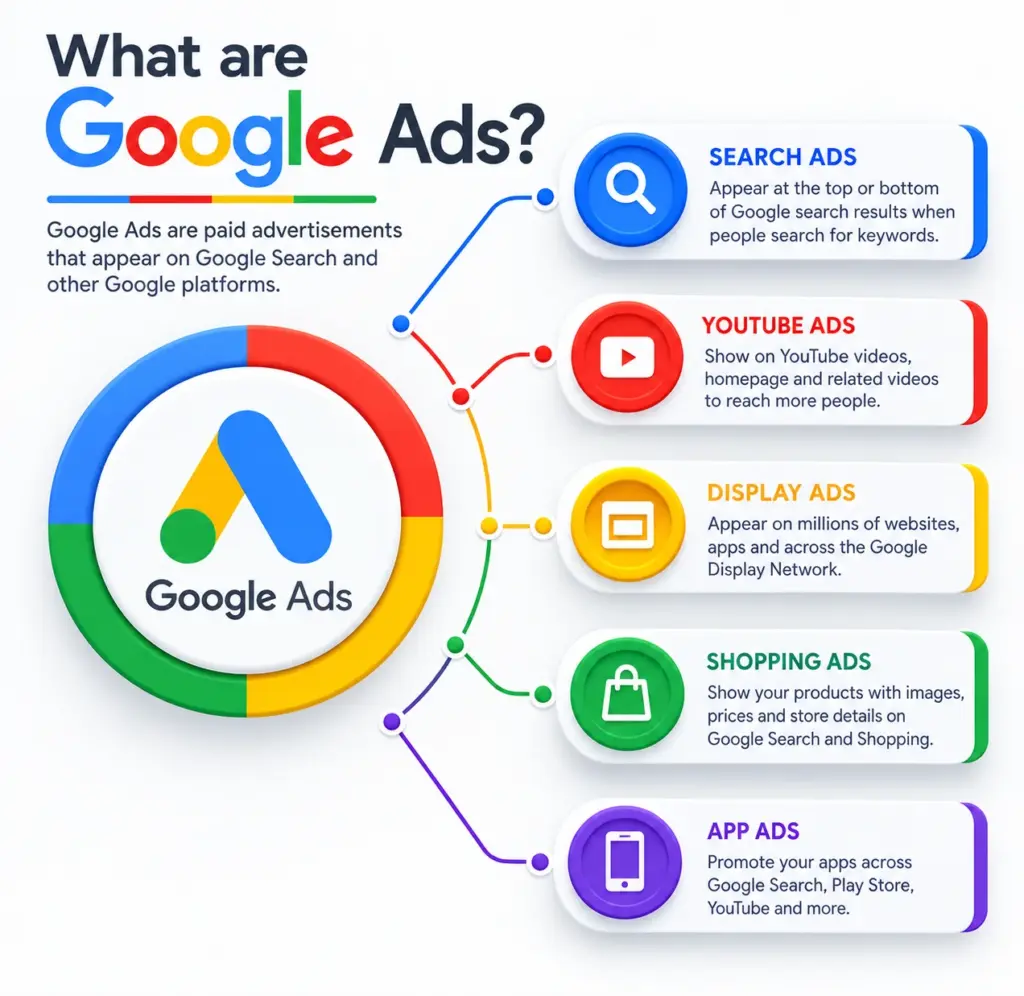
Google Ads is Google’s paid advertising platform. It allows businesses to advertise across Google Search and other Google properties, with Search campaigns giving businesses the opportunity to appear when people search for relevant products or services.
Google confirms that Search campaigns can be used to reach people while they are actively searching for what a business provides.
For example, if someone searches for “plumber near me”, a local plumbing company may be able to display an advert for that search. This makes Google Ads particularly useful for businesses that offer products or services people already know they need.
What Are Facebook Ads?
Facebook Ads are part of Meta’s advertising platform and can appear across platforms such as Facebook and Instagram. Unlike traditional search advertising, people do not necessarily need to be searching for your service before they see your advert.
Meta advertising can help businesses reach audiences based on signals such as location and interests, while Custom Audiences can also be used to reconnect with certain existing audiences. Meta’s advertising system also supports placements across Facebook and Instagram, including formats such as Reels.
What Is the Main Difference Between Google Ads and Facebook Ads?
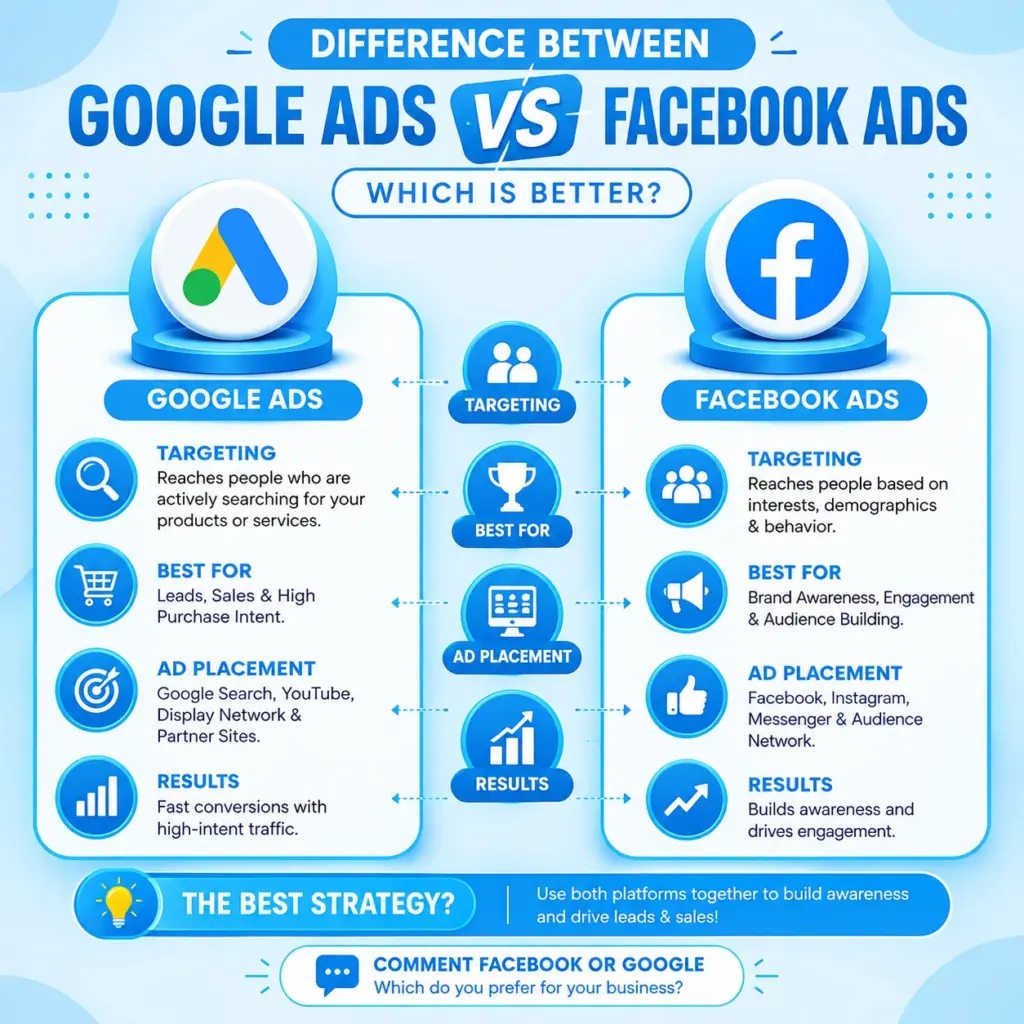
The biggest difference is usually customer intent. Google Search Ads can reach somebody at the moment they are actively searching, while Facebook Ads can put your business in front of people as they browse social content.
Think of Google Ads as helping you respond to existing demand and Facebook Ads as helping you create awareness and interest. This is a simplified comparison because both platforms offer several campaign types, but it provides a useful starting point when deciding where to spend your advertising budget.
Key differences include:
- Google Ads: Strong for capturing existing search demand
- Facebook Ads: Strong for awareness and discovery
- Google Ads: Often driven by keywords and search behaviour
- Facebook Ads: Often driven by audiences and creative
- Google Ads: Useful when customers know what they need
- Facebook Ads: Useful when customers may need to discover the offer
- Google Ads: Text-based Search Ads can be highly important
- Facebook Ads: Images and video often play a major role
Neither approach is automatically better. The right choice depends on how customers normally discover and purchase your product or service.
When Are Google Ads Better for Your Business?
Google Ads can be particularly useful when potential customers are already searching for the service you provide. If someone searches “emergency electrician near me”, “kitchen fitter in Essex” or “local waste clearance”, their search gives a strong indication of what they currently need.
Google uses keywords and other campaign settings to help match Search Ads with relevant searches. Its system also considers factors such as bidding, relevance, location targeting and landing-page quality when determining which adverts may appear.
Google Ads may work well for:
- Local trades
- Emergency services
- Professional services
- Home improvement companies
- Businesses generating quote requests
- Ecommerce businesses
- Companies with clear search demand
The stronger the buying intent behind a search, the more valuable that visibility can potentially become.
When Are Facebook Ads Better for Your Business?
Facebook Ads can be useful when you want to reach potential customers before they actively search for your business. Someone scrolling through Facebook or Instagram may not currently be searching for a new kitchen, beauty treatment or product, but the right advert can still capture their attention.
This makes creative quality extremely important. Strong images, videos, offers and messaging can introduce the problem, show the solution and encourage people to learn more about your business. Meta also supports advertising across visual placements such as Facebook and Instagram Reels.
Facebook Ads may work particularly well for:
- Visual products
- Ecommerce brands
- Beauty businesses
- Restaurants
- Fitness businesses
- Home improvement
- Events
- Offers and promotions
- Brand awareness
- Retargeting campaigns
Businesses with something visually interesting to demonstrate can often make particularly strong use of social advertising.
Which Platform Is Better for Generating Leads?
Google Ads may have an advantage when customers already have strong intent. A person searching for a specific service could be much closer to contacting a business than somebody who happens to see an advert while scrolling through social media.
However, that does not mean Facebook Ads cannot generate leads. A compelling offer combined with strong creative, effective audience targeting and a simple enquiry journey can also produce valuable enquiries, particularly when the service benefits from visual explanation or people need to see it before becoming interested.
Which Is More Expensive: Google Ads or Facebook Ads?
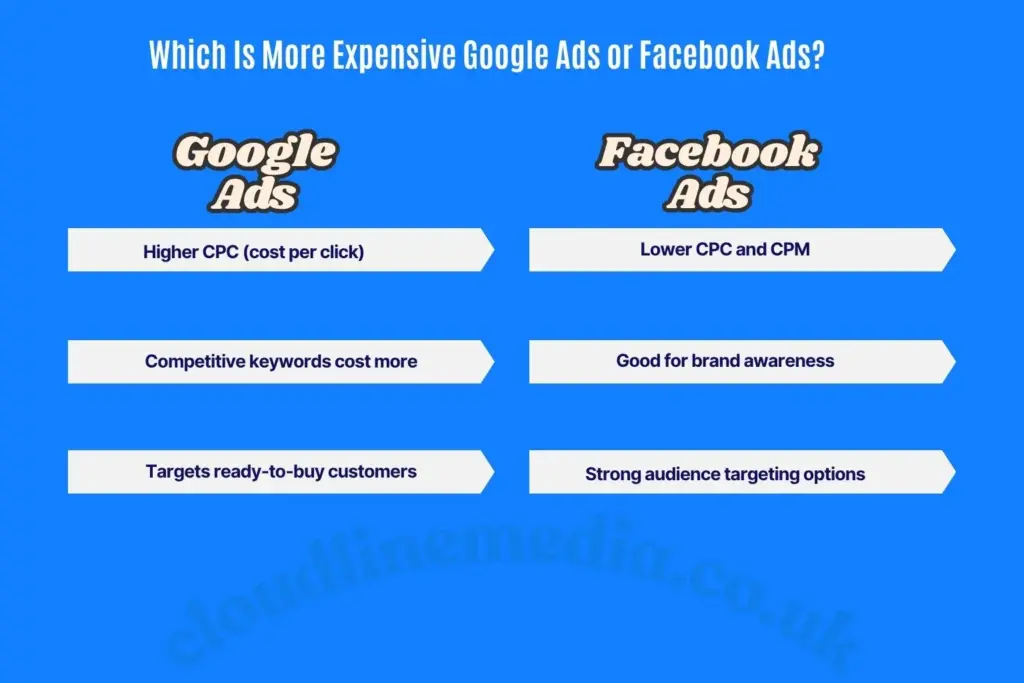
There is no fixed answer because advertising costs vary significantly. Competition, industry, location, audience, campaign objective, advert quality and bidding strategy can all influence what you pay.
Google also uses an auction whenever eligible adverts compete for advertising space, considering factors including bids and advert and landing-page quality. Instead of choosing a platform simply because clicks appear cheaper, businesses should focus on how much it costs to generate an actual customer or qualified enquiry.
For example:
Campaign A: £1 per click but very few enquiries.
Campaign B: £4 per click but regularly generates valuable enquiries.
Campaign B may still be much more profitable.
The most important figures are often cost per lead, conversion rate and return on advertising spend, rather than cost per click alone.
Google Ads vs Facebook Ads for Local Businesses
For many local service businesses, Google Search Ads can be a strong starting point because people frequently turn to Google when they already need a service. A homeowner with a leaking pipe is more likely to search for a plumber than wait for a plumbing advert to appear on social media.
Facebook Ads can still support the same local business by increasing awareness and keeping the company visible. For services with longer buying journeys, such as kitchens, bathrooms, landscaping or home renovations, social media advertising can help potential customers discover the business before they are ready to search directly.
Can You Use Google Ads and Facebook Ads Together?
Yes. In many cases, the strongest strategy is not Google Ads versus Facebook Ads but Google Ads and Facebook Ads working together.
A customer might first see your business on Instagram, visit your website and leave without contacting you. Later, they may search on Google for the service, recognise your company name and return to request a quote.
A simple journey could look like:
Facebook Ad → Brand Awareness → Website Visit → Google Search → Enquiry
Another could be:
Google Ad → Website Visit → No Enquiry → Retargeting → Return Visit → Enquiry
Using several channels can help your business stay visible across different stages of the customer’s decision-making process.
How Do You Choose the Right Advertising Platform?
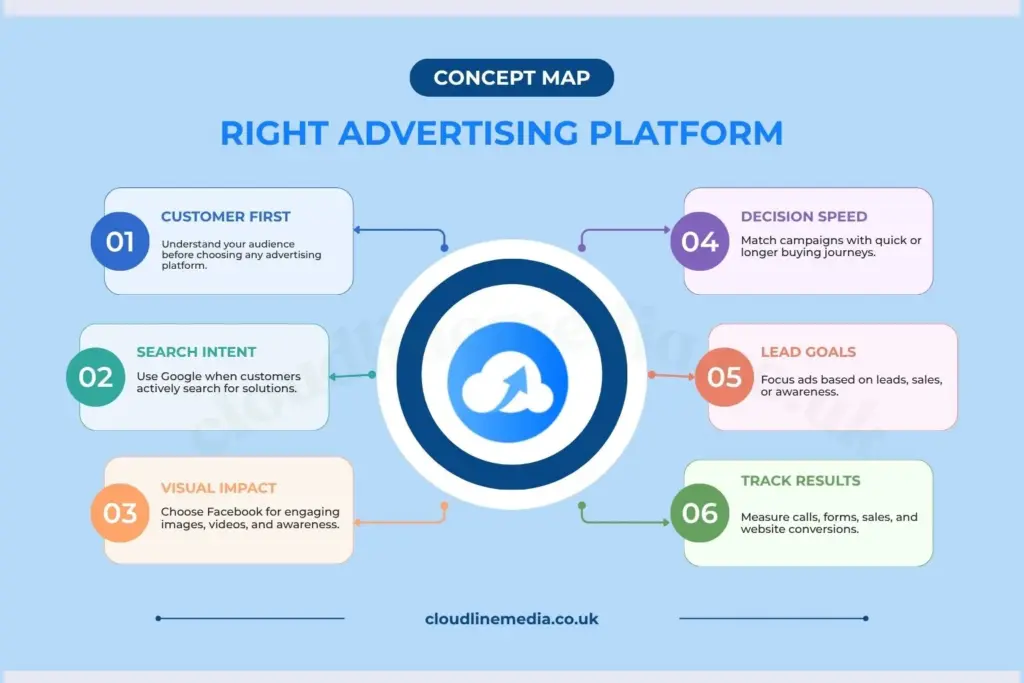
Start with your customer rather than the platform. Think about how people normally discover your product or service and how quickly they tend to make a decision.
If people actively search for your service when they need it, Google Search Ads may deserve greater attention. If your product needs strong visuals, awareness or repeated exposure before somebody becomes interested, Facebook and Instagram advertising may be worth testing.
Ask yourself:
- Are customers actively searching for my service?
- Is my product or service visually appealing?
- Do customers make quick or slow decisions?
- Am I trying to generate leads or awareness?
- Which platforms does my audience use?
- Do I have strong images or videos?
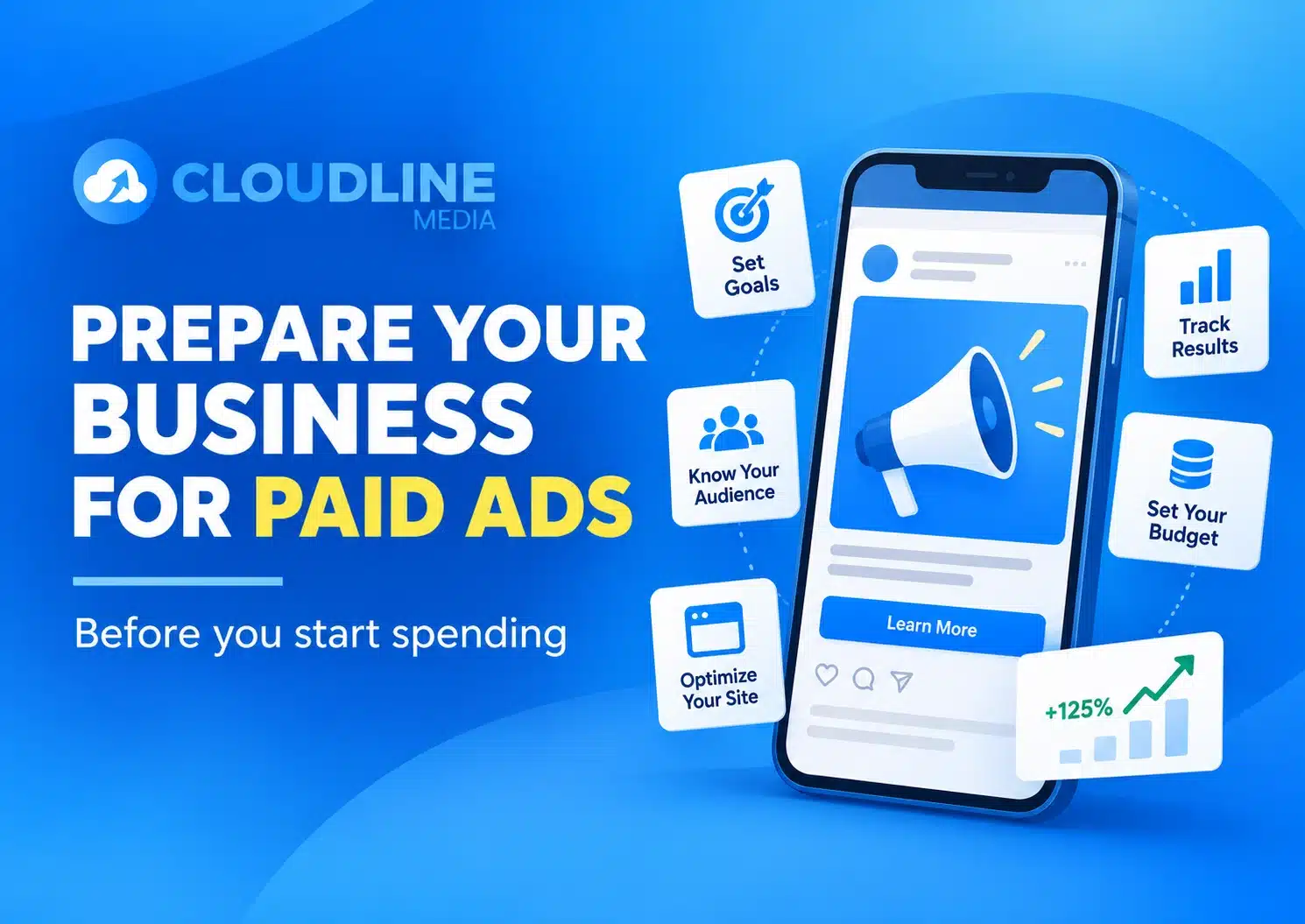
- Is my website ready to convert paid traffic?
- Can I track phone calls, forms and sales?
The answers can help you decide where your initial advertising budget should go.
Common Paid Advertising Mistakes to Avoid
The platform alone does not determine whether a campaign succeeds. Poor targeting, weak messaging or sending visitors to an ineffective website can waste money on either Google or Facebook.
Your adverts, landing pages and tracking need to work together. Google itself notes that landing-page quality and relevance can influence the Search ad auction, making the destination people reach after clicking an important part of the campaign.
Common mistakes include:
- Running adverts without conversion tracking
- Sending every advert to the homepage
- Using weak landing pages
- Targeting an audience that is too broad
- Ignoring search terms
- Using poor-quality images or videos
- Focusing only on clicks
- Changing campaigns too quickly
- Spending without a clear goal
- Failing to follow up with enquiries
Advertising should be treated as a measurable system rather than simply paying for more website traffic.
Which Is Better: Google Ads or Facebook Ads?
Google Ads may be the better option when your priority is capturing people who are already searching for your products or services. This can make it particularly useful for local services, trades and businesses where customers often have a clear and immediate need.
Facebook Ads may be better when you want to create awareness, demonstrate something visually or introduce your offer to new audiences. Businesses with longer buying journeys can also use social advertising to remain visible while potential customers consider their options.
Final Thoughts
There is no single winner in the Google Ads vs Facebook Ads debate. The best advertising platform depends on your customers, your offer, your objectives and the stage of the buying journey you want to target.
Instead of asking which platform is universally better, ask where your customers are and what they are doing when they see your advert. Test carefully, track real enquiries and sales, and invest more into the campaigns that produce genuine business results.